Community input is the process of asking residents how they want to use a park before the playground is designed. For a city, the best time to gather it is early, before any equipment is selected. It works best in four phases: plan the outreach, gather feedback, turn it into design priorities, and report back.
Done well, community input gives you more than a wish list. It gives staff a clear basis for design decisions, gives council a picture of what residents actually asked for, and builds support for the project before construction starts. Here is how to run each phase.
How Do Cities Gather Community Input for a Playground?
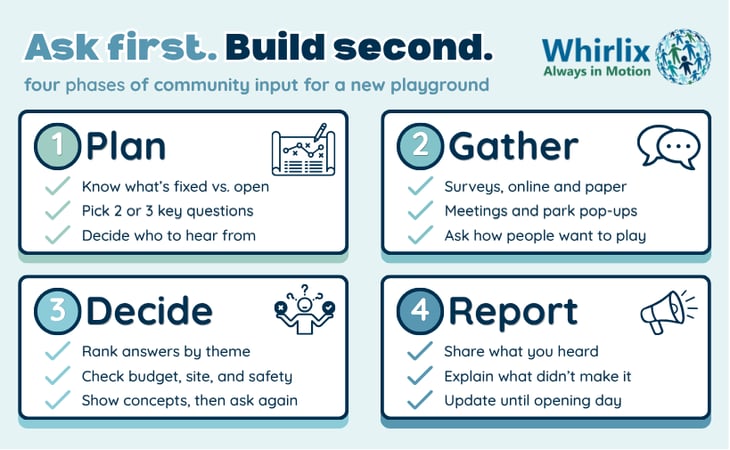
Cities gather community input for a playground in four phases: plan, gather, decide, and report back.
- Plan. Decide what is open for input, which questions you need answered, and who you need to hear from.
- Gather. Use surveys, public meetings, kid-focused sessions, and pop-ups to reach different groups of residents.
- Decide. Group the feedback into themes, rank them, and weigh them against budget, site, and safety requirements.
- Report back. Tell residents and council what you heard and how it shaped the design.
Phase 1: Plan Before You Ask
Good input starts with knowing what is actually open for input. Before the first survey goes out, separate what residents can influence from what is already fixed, such as the budget, funding source, site, timeline, and supplier options. Being upfront about those limits keeps expectations realistic and makes the feedback you get far more usable.
Next, settle on two or three questions the input needs to answer. Which age groups need more to do? What keeps families from using the park today? What would make it worth a longer visit?
Then decide who you need to hear from:
- Kids, since they are the end users
- Parents and caregivers, including families of children with disabilities
- Neighbors who live near the park
- Parks board and council members
- The maintenance crew who will care for the space
Finally, build a schedule that fits your council and budget calendars. If the project depends on a grant, check the application's public input requirements now so you collect the right documentation the first time.
Phase 2: Gather Input Where Residents Already Are
The most useful input comes from more than one method, because each method reaches a different group of residents.
- Surveys, online and on paper, reach the most people and give you numbers to report.
- Public meetings and open houses allow for conversation and follow-up questions.
- Kid-focused sessions, such as drawing activities or voting on types of play, capture what children actually want.
- Pop-ups at the park or at city events reach families who would never attend a meeting.
Whatever the method, ask how people want to play and use the space, not which products they want. "What do your kids love to do at a playground?" produces better direction than a catalog page. Cover ages, abilities, seating, and what the current space is missing. In Texas, ask about shade directly. Heat often decides when families visit and how long they stay.
Plan for the residents who do not usually show up. Offer materials in the languages your community speaks. Use the channels the city already has, such as social media, libraries, and recreation centers. Vary meeting times, and always give an option that does not require attending in person.
Phase 3: Turn Feedback Into Design Priorities
Raw survey results are not a design brief. Group responses into themes, rank them, and weigh them against the budget, the site, and the requirements that are not up for a vote. Every public playground still has to meet ASTM F1487, follow the CPSC Public Playground Safety Handbook, and comply with the 2010 ADA Standards for Accessible Design, whatever the survey says. If residents ask for play that goes beyond the minimum, that is a strong case for inclusive design.
Once priorities are clear, bring two or three concept options back to the community for a final round of feedback. People respond more precisely to something they can see than to an open question.
Document the process as you go. A short summary of who you heard from, what they said, and how it shaped the design serves your designer, your council, and your funding applications. Texas Parks and Wildlife's Local Park Grant applications, for example, ask sponsors to document public input with records such as the public meeting notice, sign-in sheet, and certified minutes, along with survey results and an explanation of how the survey was distributed. Requirements vary by program, so confirm them in the current application. Our grant funding resources are a good place to start.
Phase 4: Report Back
Closing the loop is what turns a one-time survey into lasting community support. Tell residents and council what you heard and how it shaped the design. Be just as clear about what did not make the final plan and why. Residents accept a "no" much more easily when they can see their input was considered.
Keep people updated through construction, and invite them to the grand opening. The families who helped shape the playground are the ones most likely to use it, look after it, and support the next project.
Community Input in Action: Three Texas Parks
Community input does not have to be complicated to make a difference. These three Whirlix Design projects used different methods, and each one changed the final design.
Valley Ridge Greenbelt Park: Lewisville, TX
The City of Lewisville held a public engagement event at the park, presenting design concepts on site and taking feedback for a couple of hours. One thing came through clearly. The old playground had a blue hippo, and residents knew the place as "Hippo Park." The design was revised to swap a Cozy Dome for a new blue hippo, keeping the feature that gave the park its identity. Whirlix Design served as the turnkey provider for the playground.
Dwight Eisenhower Park: San Antonio, TX
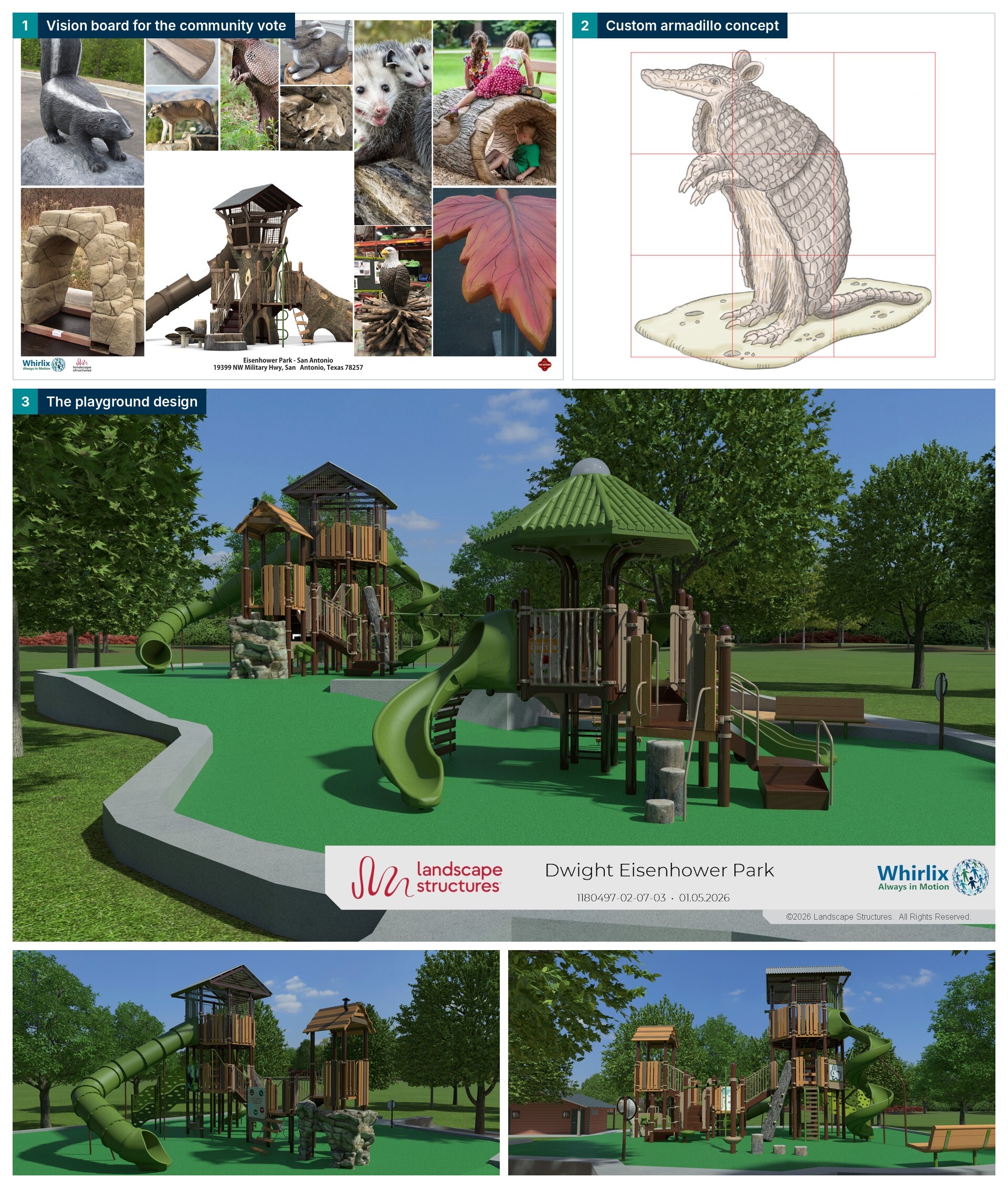
Here, the design did not exist until the community weighed in. Whirlix Design created a vision board, and residents voted on it at a community meeting held at the park. They asked for the wildlife and plants of the area: an armadillo, an eagle, an opossum, bats, snakes, native plants and flowers, and a tree house. The result is a nature-inspired playground built around those requests. Whirlix presented concepts, worked with the city and its natural area committee, and developed the design for approval. Installation is planned by the end of 2026.
Celebration Park: Allen, TX
In Allen, a community survey sharpened priorities the city already had. Of the residents who responded, 92% live within Allen city limits. Shade was on the list from the start, but the results moved it to the top. It was the most requested feature for both the play area and the sprayground, and shade structures took the first two spots among the survey's top five priorities, ahead of adventure elements, towers, and swings. In the open-ended comments, shade and fencing stood out most. That feedback put more weight on fencing as well, with the goal of a safer and more inclusive space where children cannot easily wander off. The project is still in the design stage, and those priorities are guiding the concept Whirlix Design developed for the city.
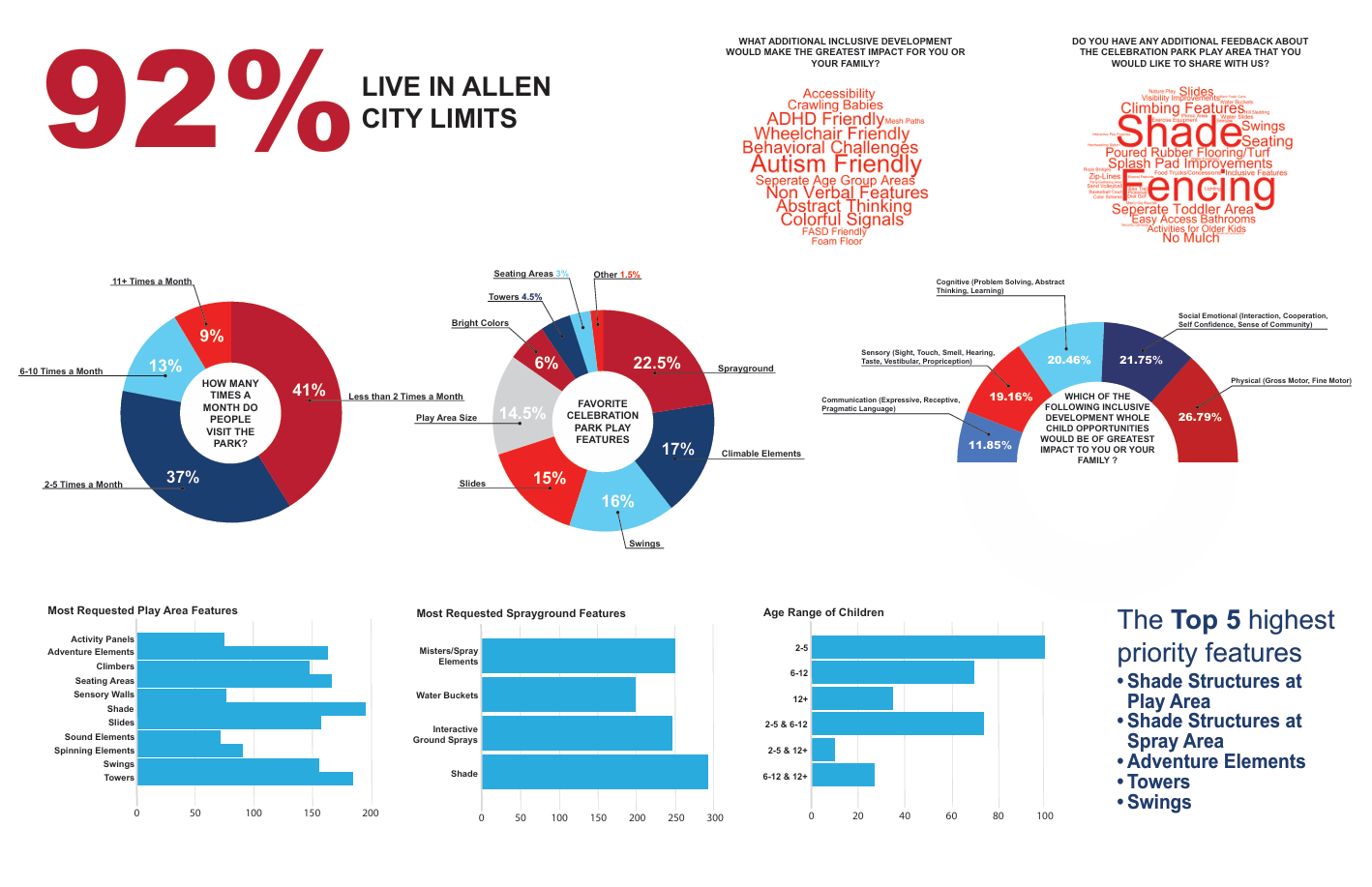
Survey results for Celebration Park in Allen, Texas. Shade led the most requested features for both the play area and the sprayground, and shade and fencing stood out in the open-ended feedback.
How Whirlix Design Can Help
You do not have to run this process alone. Whirlix Design's in-house design team provides on-site evaluation, needs assessment, and 2D and 3D design concepts that cities can bring to public meetings and council sessions. Concepts at different budget levels help keep community feedback grounded in what the project can deliver.
For more on the steps that follow, see our Playground Planning Guide.
Frequently Asked Questions
What is community input in playground planning?
Community input is the process of asking residents how they want to use a park before the playground is designed. Cities typically gather it through surveys, public meetings, kid-focused sessions and pop-up events.
When should a city start gathering community input for a playground?
Start before any equipment or layout is selected, ideally as soon as the site and budget range are known. Input gathered after a design is chosen is much harder to act on.
How many survey responses does a city need?
There is no fixed number. What matters is whether the responses reflect the neighborhoods, age groups and abilities the park will serve.
What if residents want more than the budget allows?
Share the budget early and ask residents to rank priorities instead of listing everything they want. A phased plan can show what comes first and what could be added later.
Does community input help with playground grant applications?
It can. Many funders look for a documented community need, and some require records such as meeting notices, sign-in sheets and survey results.
Start the Conversation
The playgrounds that communities love most usually began with a city that asked good questions early. If you are planning a new or replacement playground and want help turning community input into a design, contact Whirlix Design to start the conversation.