
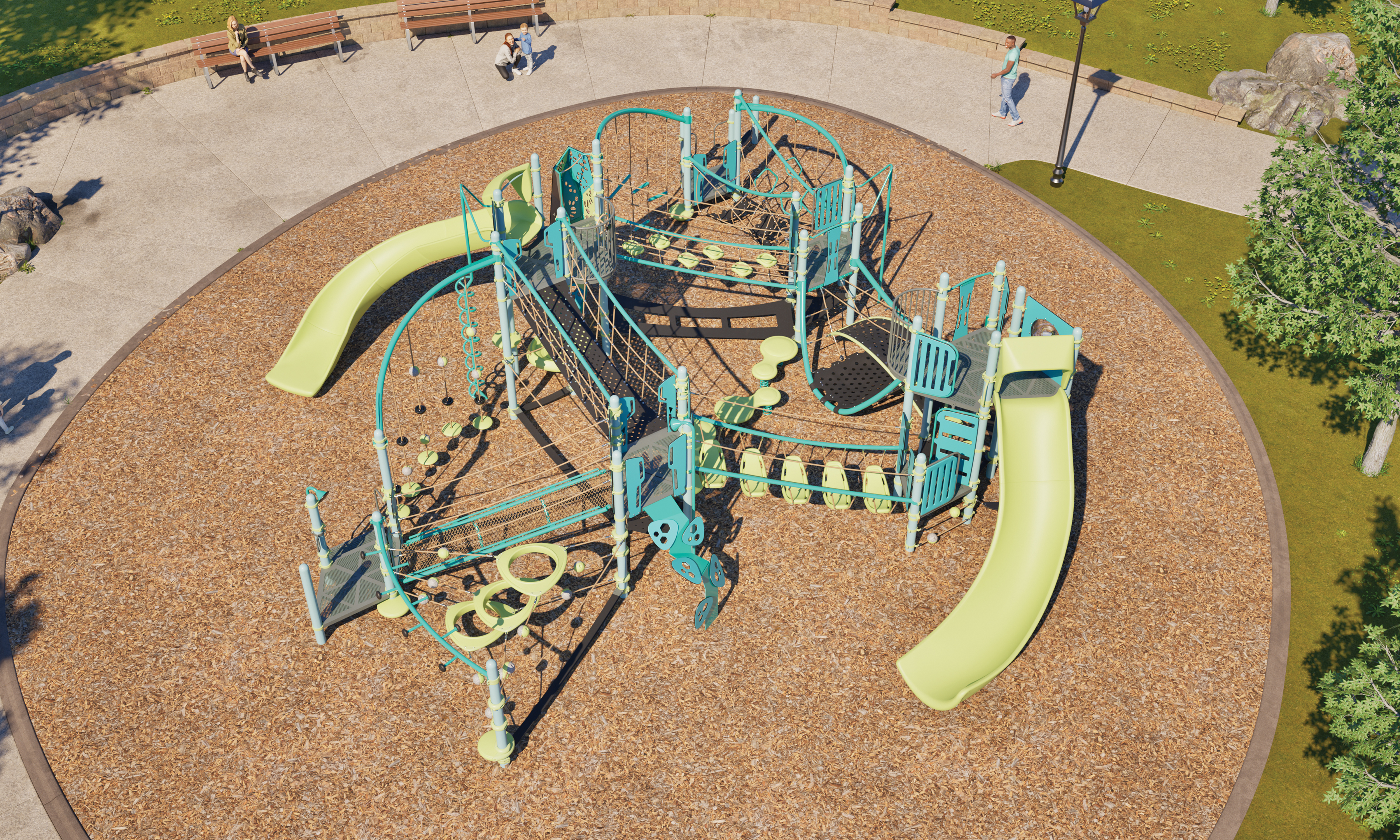
In 1984, Landscape Structures introduced the PlayBooster® playsystem, a breakthrough in playground design that would go on to become one of the most enduring and influential systems in the industry. PlayBooster® was built on what was then a novel idea: a post-and-clamp modular system that allowed unlimited configuration of play elements, giving designers unprecedented flexibility to tailor play environments to site needs, community goals, and developmental priorities.
Unlike earlier playsystems that had fixed layouts, PlayBooster® empowered designers to mix and match climbers, slides, overhead events, bridges, and other components to create playful, flowing environments that encouraged whole-body movement, exploration, and social interaction. These systems blended ground-level activities with vertical challenge and interconnected pathways, inviting children to climb, slide, crawl, swing, and engage in the kind of imaginative play that supports physical strength, coordination, and creativity.
From the beginning, durability and adaptability were central to the PlayBooster® design. Its robust post-and-clamp construction was engineered for minimal maintenance and maximum longevity—attributes that quickly made it a favorite choice for parks, schools, and community spaces looking for long-lasting, customizable play solutions. Over time, the product family continued to evolve, updating components to meet new safety standards and expand accessibility, helping playground designers deliver inclusive, dynamic play experiences across diverse communities.
Today, decades after its introduction, PlayBooster® remains a gold standard for quality, versatility, and imaginative play design. Its influence can be seen in countless playgrounds that continue to serve generations of children - encouraging not just physical activity, but social connection, problem-solving, and joyful discovery.
What Makes This Collection Different: A Design Perspective
When Landscape Structures unveiled the reimagined PlayBooster collection at their 2025 Annual Sales Meeting on January 19, 2026, they weren't just updating products—they were answering a fundamental question: How do we create play structures that keep kids genuinely engaged, moving, and challenged throughout their entire play session?
As the exclusive Landscape Structures representative for North and Central Texas, we've watched playground trends evolve for years. What excites us most about this collection is how it addresses real challenges our clients face: creating spaces where children of varying abilities find their own path, where active play happens naturally without forced activities, and where the structure itself invites exploration rather than dictating it.
Landscape Structures describes this as "the future of three-dimensional dynamic, highly active play," and from a design standpoint, that's exactly right. This isn't about adding more components—it's about reimagining how those components work together to increase everyday playability through countless active moments at every decision point. Kids discover vertical circuits, opportunities for parallel play, and under-deck activation that transforms the entire structure into one continuous adventure.
Let's walk through what sets each component apart and how these design innovations translate to better play experiences for Texas communities.
Roofs & Slides: Defining Destinations
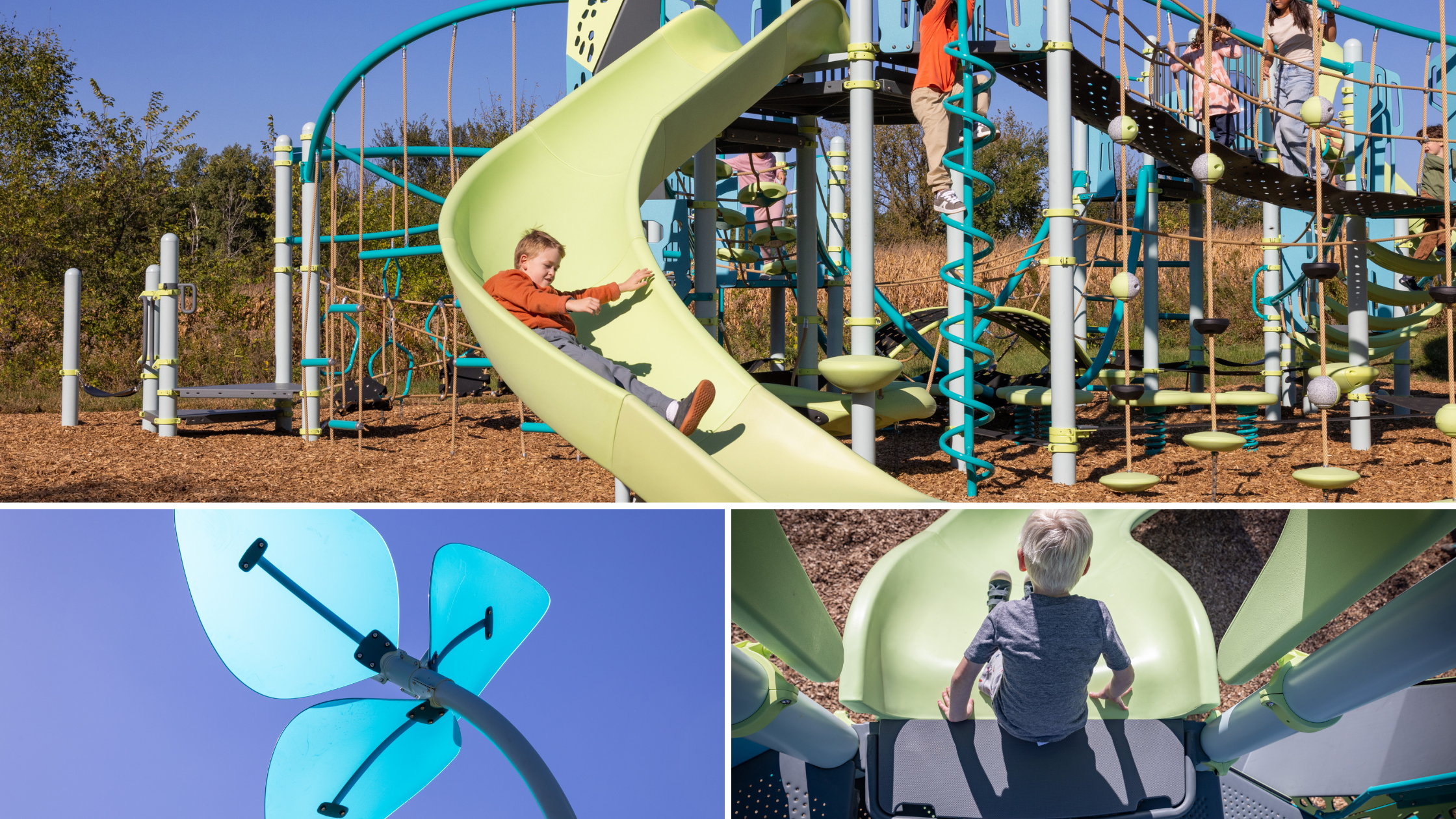
FlowWinder™ Slide (Model #363737) Spiral slides have been playground staples for decades, but the FlowWinder™ takes a fresh approach. The contemporary curved profile doesn't just look modern—it creates smoother transitions and better momentum control, which means more confident riders and less supervision stress for your staff. We're seeing this become a signature element in designs where visual impact matters, like highly visible community park installations or school campuses where the playground serves as a landmark.
SlideRiser™ Deck (Model #363737) Here's where smart engineering meets practical design. The SlideRiser™ isn't just a platform—it's a purpose-built transition zone that maintains play flow while meeting safety standards. For our municipal clients managing high-traffic sites, this component creates natural queuing space without bottlenecks, keeping active play moving even during peak usage times like recess or summer camp sessions.
Petal Canopy (Model #368212) Texas sun demands serious shade solutions, and the Petal Canopy delivers both function and form. The organic petal geometry creates shade coverage where you need it most—over high-dwell areas like platforms and transfer points—while the distinctive silhouette makes your playground instantly recognizable from across the park. We recommend this for projects where aesthetics influence community perception, like downtown parks or school entrance zones.
Climbers: Creating Vertical Circuits
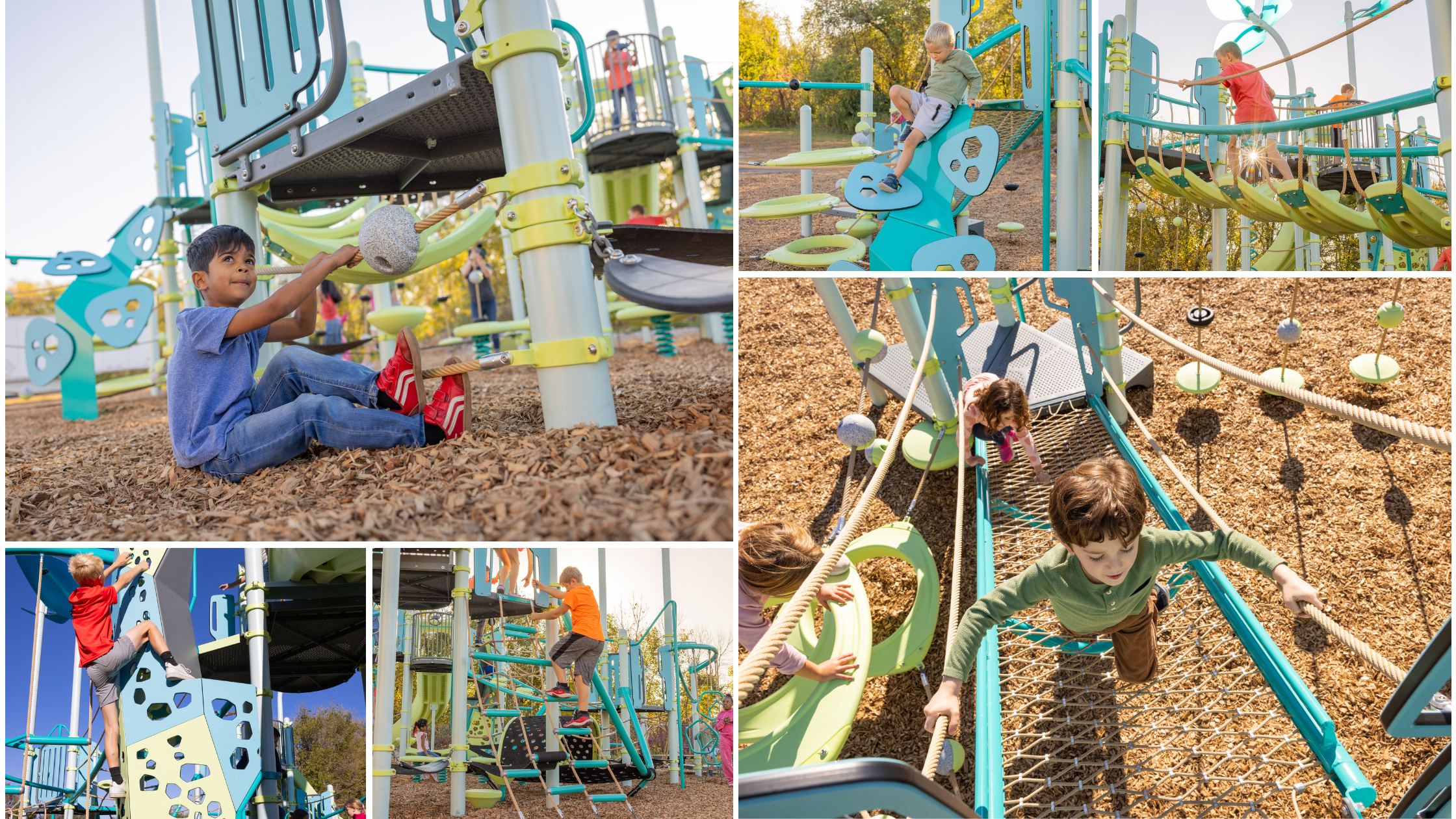
One of the most significant shifts in this collection is the climber variety. Rather than one or two climbing options, you're now looking at a diverse toolkit that lets us design genuine vertical circuits—multiple climbing challenges that accommodate different skill levels and movement preferences within a single structure.
Abacus™ Climber (Model #373009) This is cognitive play meets physical challenge. The sliding beads add a manipulative element that engages younger or less confident climbers while the vertical challenge appeals to everyone. In mixed-age environments like community parks serving ages 5-12, this creates an inclusive entry point that doesn't feel "babyish" to older kids.
BeltSwoop™ Climber (Model #363635) The sweeping belt design creates what we call "discovery climbing"—multiple approaches and grip strategies that kids figure out themselves. This is particularly valuable in environments that serve neurodiverse populations, where predictable ladder rungs might not engage the same way varied, problem-solving routes do.
Crossbar™ Climber (Model #363735) Sometimes straightforward is exactly what you need. The Crossbar™ offers classic upper-body challenge with updated aesthetics. We spec this for projects where traditional play patterns are valued but contemporary design standards are expected—think suburban schools or park district replacements where community members have fond memories of "monkey bars" but expect modern safety features.
Crux™ Climber (Model #360412) Every great playground needs challenge moments—those sections that aren't for everyone but create genuine achievement for kids who attempt them. The Crux™ fills that role intentionally, creating a physical and psychological peak within the structure that older or more skilled users seek out. This is how you keep 10-12 year olds engaged when most playground equipment skews younger.
FlexxWay™ Climber (Model #373141) Flexible, responsive climbing introduces vestibular input and core engagement that static climbers can't match. From a sensory play perspective, this component activates proprioceptive feedback—the body awareness that helps kids develop coordination. We're seeing high interest in this from school districts focused on sensory-inclusive design and occupational therapy-informed play environments.
Lotus™ Climber (Model #373471) When your playground serves as community focal point—think city park centerpieces or campus quad installations—the Lotus™ brings sculptural quality that elevates the entire space. The petal geometry creates Instagram-worthy moments while delivering genuine climbing variety. We've found this particularly effective in projects where public art budgets exist but getting separate art installations approved proves challenging.
O-Zone® Array Climber (Model #372400) The O-Zone® system already had proven play value; this array configuration expands how you can deploy it within structures. The circular elements create spatial reasoning challenges—kids have to think three-dimensionally about their route—which engages cognitive development alongside motor skills. Great for STEM-focused schools or districts emphasizing developmental play outcomes.
PodHopper™ Climber (Model #363633) Balance, timing, and route planning all combine in the PodHopper™. Each platform requires deliberate movement, which naturally paces play and creates rhythmic climbing that's less exhausting than continuous vertical ascent. We recommend this for structures where you want sustained engagement without burnout—summer camp settings, childcare facilities, or anywhere kids might be playing for extended sessions.
SaddleStep™ Climber (Model #363634) Ergonomic design might sound technical, but it translates to better accessibility across age and ability ranges. The saddle-shaped steps accommodate different foot sizes and climbing styles more naturally than flat rungs, which means more successful climbing attempts and fewer kids who give up halfway. Particularly valuable in inclusive play environments or 2-12 age range designs.
VertiGo™ Deck-to-Deck (Model #373115) Vertical deck-to-deck connections create dramatic sightlines and serious climbing challenges. This is your "wow factor" component—the one that makes people stop and look. From a practical standpoint, it enables elevated play zones without excessive ground-level footprint, maximizing play value within tight site constraints. We spec this frequently for urban parks and school playgrounds with limited space.
VertiGo™ Ground-to-Deck Climber (Model #373073) First impressions matter. The ground-to-deck VertiGo™ creates an immediate visual invitation to vertical play while establishing the structure's challenge level from approach. We position this strategically in designs to draw users toward specific play zones or to balance circulation patterns across the structure.
Bridges & Ramps: Connecting the Experience
Bridges aren't just transitions—they're play events themselves. The reimagined collection treats these connectors as integral experiences rather than functional necessities, which fundamentally changes how kids move through structures.
Crossbar™ Bridge (Model #362045) The geometric transparency of the Crossbar™ Bridge maintains visual supervision lines while creating genuine balance challenges. For park directors and school administrators concerned about monitoring active play, this offers both safety compliance and engaging play value—kids are challenged but always visible to supervising adults.
Pentagon Bridge (Model #361509) Angular geometry creates unpredictable footing that demands attention and careful movement. This is intentional challenge design—the kind that builds proprioceptive awareness and motor planning skills. In therapy-informed playground designs or inclusive play environments, these seemingly small variations in surface geometry create significant developmental opportunities.
SwiggleKnots® Bridge Inclined (Model #361785) Adding incline to the SwiggleKnots® experience transforms a horizontal challenge into an elevation change that increases difficulty without requiring additional structure height. This creates graduated challenge—kids can attempt the level version first, then progress to the inclined bridge as confidence builds. Excellent for age-transitional designs where 5-year-olds and 10-year-olds share the same structure.
Slack Line w/ Cable Guide (Model #373149) Balance challenges resonate with today's kids who've grown up seeing slack-lining in parks and social media. The cable guide provides enough support to make success achievable while maintaining authentic balance challenge. We're seeing strong interest in this from districts emphasizing outdoor skills and nature-based play, particularly in suburban and rural Texas communities.
Slack Line (Model #373148) The unassisted slack line is pure challenge—no training wheels, no assistance. This creates those genuine achievement moments that keep older kids engaged with playground equipment they might otherwise age out of. When designing for middle school or upper elementary environments, components like this become crucial retention elements.
Motion & More Fun: Activating Every Zone
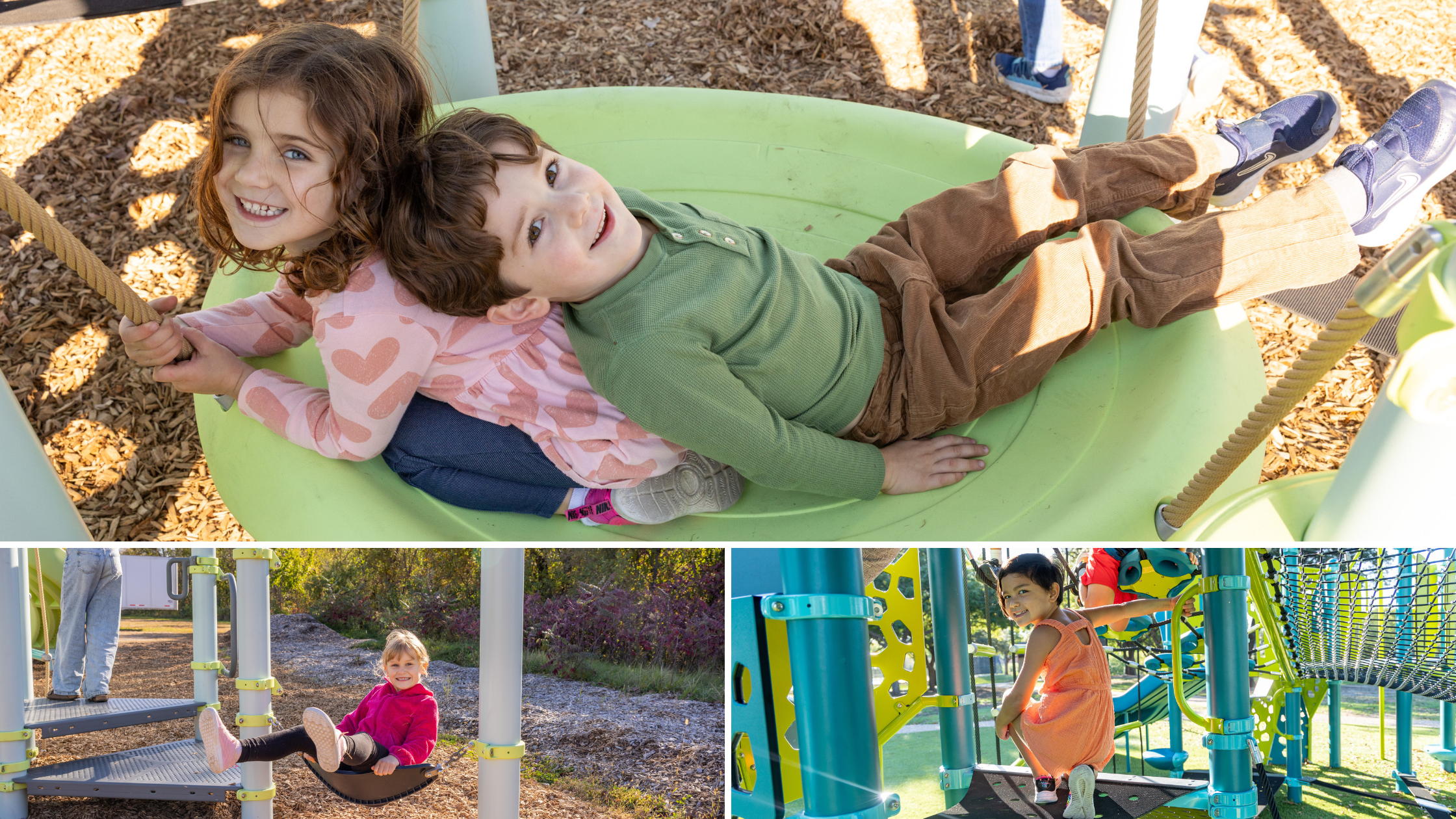
Under-deck activation and parallel play opportunities—these are the design concepts that separate mediocre playgrounds from great ones. The Motion & More Fun category addresses spaces that often become dead zones in traditional structures.
Cable/Ball Assembly (Model #373119) Manipulative play at deck level creates inclusive participation points for kids who might not be ready for intense climbing or sliding. This serves multiple purposes: sensory engagement for younger users, calming activities for overstimulated children, and creative play opportunities that balance the structure's high-energy elements. Essential in designs serving diverse ability levels.
HomeBase™ Square Belt (Model #362348) Social gathering spaces within active play structures are often overlooked, but they're critical for sustained engagement. The Square Belt creates a motion-rich meeting point where kids naturally congregate, rest, and plan their next move. We position these strategically in designs to create natural circulation breaks and social hubs within the play flow.
HomeBase™ Tri Belt (Model #362354) The triangular configuration increases capacity while creating conversational geometry—three kids facing each other rather than sitting in a row. This subtle design choice dramatically increases social interaction quality. Particularly effective in school playground designs where peer interaction and social skill development are explicit program goals.
Oodle® Seat (Model #363738) The Oodle® has proven play value that generations of kids have enjoyed. Bringing this motion experience into the reimagined PlayBooster system maintains that beloved element while integrating it into contemporary design aesthetics. For communities replacing aging playgrounds, this provides continuity—familiar motion in an updated package.
Rocker Seat (Model #373136) Rhythmic, self-directed motion offers vestibular input that many children seek naturally. The rocking motion also creates natural pause points in play sessions—kids rest while still engaging with motion, which extends overall play duration. From a design perspective, this activates platform space that might otherwise be underutilized, maximizing your structure's play value per square foot.
Designing Your PlayBooster Structure: Next Steps
The reimagined PlayBooster collection gives us unprecedented flexibility to create playgrounds that respond to your community's specific needs—whether that's maximizing challenge for older kids, creating inclusive play for all abilities, activating limited space efficiently, or designing signature installations that define your park or campus.
At Whirlix Design, we approach every PlayBooster design as a collaborative process. We consider your site constraints, user demographics, budget parameters, and community goals to select and arrange these components into structures that deliver genuine play value for North and Central Texas communities.
Ready to explore what's possible?
Our team can provide customized designs, budget estimates, and site-specific recommendations. We'll walk you through component selection, color customization, and surfacing options to create a playground that serves your community for years to come.
Contact our team to start designing your PlayBooster structure!