
.jpg)
A nature-inspired playground uses a site's landscape, native plants, topography and local ecology to shape the play experience, instead of simply adding green equipment or a few trees. The best ones blend manufactured play equipment with the surrounding environment so the space feels rooted in its community.
The strongest nature-inspired spaces consider the entire site, from topography and plantings to color, materials, water, shade and local ecology, and use those elements together to create a play environment that feels connected to its surroundings.
For park planners, landscape architects, schools and communities considering nature-inspired play, the process should begin well before equipment is selected.
7 elements of nature-inspired playground design:
- Start with the site
- Use color to establish the environment
- Make topography part of the play experience
- Incorporate natural materials, forms and textures
- Integrate landscaping into the play space
- Look beyond the landscape: water and sky
- Design for the whole community
1. Start With the Site
.png?width=1121&height=730&name=nature%20-%20inspired%20blog%20visuals%20(3).png)
Every strong nature-inspired design begins with what makes the site distinctive: its landscape, wildlife and history. Before deciding what a nature-inspired playground should look like, look at what's already there. What defines the landscape? Existing trees, elevation changes, water features, views, wildlife and native plant communities can all provide inspiration. So can the site's history and the community surrounding it.
The best nature-inspired playgrounds don't rely on a generic "nature" theme. They reflect the specific place they're in. A wetland-adjacent park might highlight local bird species. A playground near a lake could reference fish and aquatic habitats. A site with a distinctive geological feature might incorporate similar forms and textures into climbing components.
Community history can be equally important. A former orchard, ranch, farm or industrial site may provide design cues that connect the new playground with the people and activities that shaped the land before it. This is also where community engagement can be particularly valuable. Residents, parks staff and other local stakeholders often know the stories, landscapes, wildlife and landmarks that give a place its identity. Those insights can become meaningful design elements rather than simply decorative themes.
Localizing the design is what turns a playground into this community's park instead of a generic playground that could have been installed anywhere.
2. Use Color to Establish the Environment
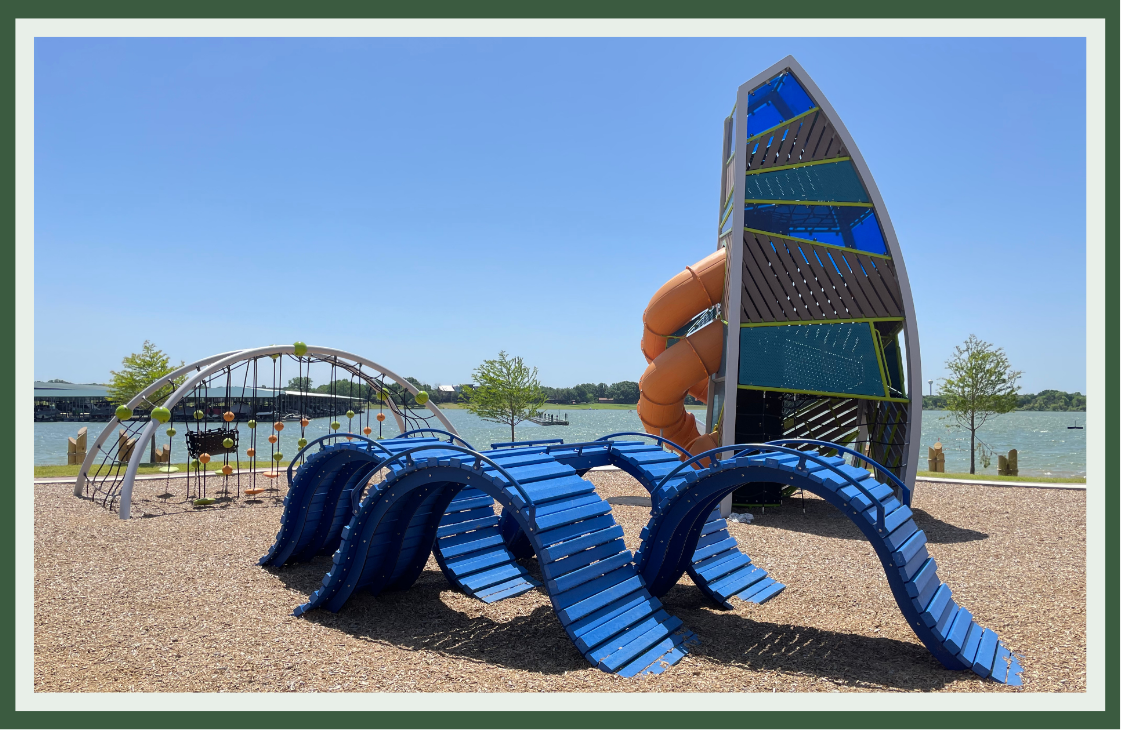
Color is one of the most cost-effective ways to connect a playground to its surroundings. Landscape-inspired palettes like greens, ambers, browns, blues and other earth tones can help playground structures blend into their surroundings or evoke a particular ecosystem.
But nature-inspired doesn't have to mean muted.
A desert community might draw from terracotta, warm sand and the brilliant colors of native flowers. A lakeside park might use blues, greens and aquatic accents. A prairie-inspired playground could combine grasses and earth tones with brighter wildflower colors.
Color can also be used intentionally to create contrast or introduce an imaginative environment that isn't naturally present in the surrounding landscape. The goal isn't simply to make everything green and brown. It's to create a palette that reinforces the story you're trying to tell.
3. Make Topography Part of the Play Experience
.png?width=1121&height=730&name=nature%20-%20inspired%20blog%20visuals%20(8).png)
Slopes and elevation changes add play value and can double as accessible routes to play. Nature is rarely flat and nature-inspired playgrounds don't have to be either. Hills, slopes and varied elevations can provide significant play value, giving children new ways to climb, roll, navigate and explore.
Topography can also do important work for accessibility. A gentle slope adjacent to a slide or net structure, for example, can create another way to reach a play experience. Changes in elevation and sloped surfacing can also provide physical and visual cues that help children understand and navigate a space. In this way, elevation can become a tool for inclusion as well as adventure.
The key is to consider topography early in the design process. When grading, accessible routes, play equipment and surfacing are planned together, elevation can become an integral part of the play experience rather than simply a site condition the playground must work around.
4. Incorporate Natural Materials, Forms and Textures
.png?width=1121&height=730&name=nature%20-%20inspired%20blog%20visuals%20(9).png)
Manufactured materials like GFRC can replicate rock, bark and logs while meeting public playground safety and durability requirements. Today's manufactured playground equipment can replicate natural forms with a remarkable degree of realism. Materials such as Glass Fiber Reinforced Concrete (GFRC), for example, can be molded and professionally finished to resemble actual rock formations, tree bark, logs and other natural elements. That allows designers to introduce realistic climbers, steppers and sculptural components while still addressing the safety, durability and maintenance requirements of a high-use public playground.
Natural inspiration can also be much more subtle. Leaf-shaped panels, log tunnels, stone-like steppers, branch-inspired climbers and tactile textures can reinforce the overall design without attempting to replicate an entire natural environment.
The objective is to find the right balance between the experience you're trying to create and the practical requirements of the site.
5. Integrate Landscaping into the Play Space
.png?width=1121&height=730&name=nature%20-%20inspired%20blog%20visuals%20(2).png)
Trees and plantings can become part of play, but only if the community can maintain them. Landscape shouldn't be treated simply as decoration surrounding the playground. It can become part of the play experience itself. Trees, flowers, grass and planting pockets can be integrated throughout a site rather than confined to its perimeter. Vegetation can help establish scale, reinforce themes, provide seasonal interest and create a stronger visual connection between the playground and the surrounding park.
But integrating living landscape elements into a play environment requires careful planning. Trees located within or adjacent to playground use zones should be evaluated against ASTM F1487 and the CPSC Public Playground Safety Handbook. Trees used for shade also require ongoing debris cleanup, inspection and limb maintenance. In Texas, shade trees often work best alongside shade structures while new plantings mature.
Planting pockets bring similar considerations. Before incorporating them, teams should realistically evaluate whether staffing and maintenance resources are available to care for the landscape over the life of the playground.
The best planting plan isn't simply the one that looks best on opening day. It's one the community can successfully maintain for years to come.
6. Look Beyond the Landscape: Water and Sky
.png?width=736&height=479&name=nature%20-%20inspired%20blog%20visuals%20(6).png)
Water play and overhead elements extend a nature theme into all three dimensions.
Water adds an entirely different sensory layer. A full splash pad can evoke a river, lake or coastline, with faux tree trunks, rocks or fish reinforcing the idea. But water doesn't require a full splash pad. Interactive channels, ground sprays, misting, thematic surfacing or visual references to a local watershed can make the same connection.
Then look up. The sky and air are part of the natural environment too.
Climbing towers, net structures and elevated play elements can evoke clouds, kites, tree canopies and open sky. Shade structures can become part of the visual story as well, using form and color to suggest sails, leaves, clouds or canopies while also improving comfort within the play environment.
Thinking beyond the ground creates opportunities to make the entire three-dimensional space part of the experience.
7. Design for the Whole Community
.png?width=1121&height=730&name=nature%20-%20inspired%20blog%20visuals%20(10).png)
Accessibility and inclusion should shape the design from the start, not be added afterward. A successful nature-inspired playground shouldn't simply look different. It should give people different ways to experience the space. That means considering accessibility and inclusion from the beginning rather than adding them after the major design decisions have already been made. (See our guides to inclusive playground design and age-appropriate play.)
Accessible routes, as defined in the 2010 ADA Standards, can be integrated with topography. Sensory elements can use sound, texture, movement and natural imagery. Gathering spaces can create opportunities for social play. Quiet or lower-stimulation areas can give children places to retreat and observe.
Different degrees of physical challenge can also give children more choices about how they participate.
The same principle applies to adults.
Seating, shade, circulation and gathering spaces influence whether parents, grandparents and caregivers can comfortably spend time in the park. A playground that invites families to stay longer can become a community space rather than simply a place children visit for a few minutes.
Nature-inspired design works best when the entire experience, not simply the equipment, is considered together.
Nature-Inspired Play in Action: Miller's Pond Park
.png?width=1121&height=595&name=Miller%E2%80%99s%20Pond%20Park%20(1).png)
Miller's Pond Park in San Antonio demonstrates how local context can become the foundation for an entire playground concept. The city wanted the playground to feel like a natural extension of the well-loved green space on San Antonio's Southwest Side, located along the water's edge. The design leans directly into the pond's fishing culture.
Cattail-shaped posts rise from the playground. Blue-green lily-pad steppers reference the water. A wooden fishing-boat SwayFun® glider includes its own captain's wheel, while a playful "Bait & Tackle" shop panel extends the story. Digifuse® panels featuring native fish species actually stocked in the pond add another layer of site-specific detail.
With the pond visible beyond the playground, those elements don't simply create a fishing theme. They connect the play experience to something children can actually see and experience in the surrounding park. Children can imagine a day on the water while playing only steps away from the real thing.
Miller's Pond illustrates an important lesson for nature-inspired design: you don't necessarily have to introduce a new story. Sometimes the strongest playground concept is already sitting right outside the playground.
From Inspiration to Implementation
Once the concept begins taking shape, several practical considerations can help keep a nature-inspired playground on track.
Think beyond the play equipment. Surfacing, shade, seating, pathways, topography, landscaping and water features can all contribute to the overall experience. Considering the site, as a whole, creates a more cohesive result than selecting nature-themed equipment after the rest of the park has already been designed.
Balance manufactured equipment with natural elements. Raw natural-material playgrounds can create beautiful experiences, but manufactured equipment inspired by nature may provide a practical combination of safety certification, durability, accessibility and manageable long-term maintenance for busy public spaces.
Plan for budget early. Custom GFRC elements, extensive grading, landscaping and water play can affect project costs. Identifying priorities early allows the team to determine where customization will have the greatest impact and explore funding opportunities when necessary. Our guides to writing a playground grant proposal and funding questions can help.
Build the right team early. Playground designers, landscape architects, parks staff and other project partners can work together to balance creative vision with accessibility, safety, site conditions, budget and long-term maintenance.
Let the Site Tell the Story
Nature-inspired play isn't a single product or a passing style. It's a mindset that treats the natural world as inspiration, material and context all at once.
Done well, it transforms a playground from a collection of play components into a place that feels connected to its surroundings, its community and the people who experience it.
And every site provides a different starting point. The question isn't simply, "How do we make this playground look like nature?" A better question is: "What's distinctive about this place and how can play bring that story to life?"
Frequently Asked Questions
How much does a nature-inspired playground cost?
It depends on scope. Color and prefabricated themed components usually add the least cost. Custom GFRC, extensive grading, landscaping and water play add the most. Setting priorities early shows where customization will have the greatest impact.
Can trees be placed inside a playground use zone?
Trees near play equipment need to be evaluated against ASTM F1487 and CPSC guidance on use zones. A professional playscape designer and/or Certified Playground Safety Inspector can assess specific placements.
Are natural-material or manufactured playgrounds better?
Raw natural materials can create beautiful spaces, but manufactured equipment inspired by nature typically offers durability, accessibility and more manageable maintenance for busy public parks.
Can a nature-inspired playground be inclusive?
Yes. Sloped accessible routes, sensory elements, quiet spaces and varied levels of challenge fit naturally into nature-inspired design when planned from the beginning.
How much maintenance does a nature-inspired playground need?
Manufactured components are maintained like standard equipment. Living elements like trees and planting pockets need ongoing care, so confirm staffing and resources before including them.
Ready to Bring Nature-Inspired Play to Your Space?
Whirlix Design can help explore how equipment, landscape, surfacing, shade, water features and site amenities can work together to create an outdoor space rooted in the character of your community. Start a conversation with our team.